Sarah (Sally) C. M. Paine: The Historian That is About to Get Internet Popular

She doesn't have a Twitter account. She doesn't have a podcast. But she is about to become the most important voice on your feed.
Inspiration: My track record of spotting figures like Prof G, Alex Hormozi, and Palmer Luckey before they hit the mainstream.
I have a knack for spotting “intellectual influencers” right before they tip.
It’s always the same pattern.
- They have deep, undeniable expertise (not just opinions).
- They have a unique, sticky framework for the world.
- They start appearing on high-signal podcasts (Dwarkesh Patel, Lex Fridman) and the comments section goes wild.
The next one is Sarah C.M. Paine (or “Sally” to her friends). She is a Professor of History and Strategy at the Naval War College.
And she is a storytelling genius.
Who is Sarah Paine?
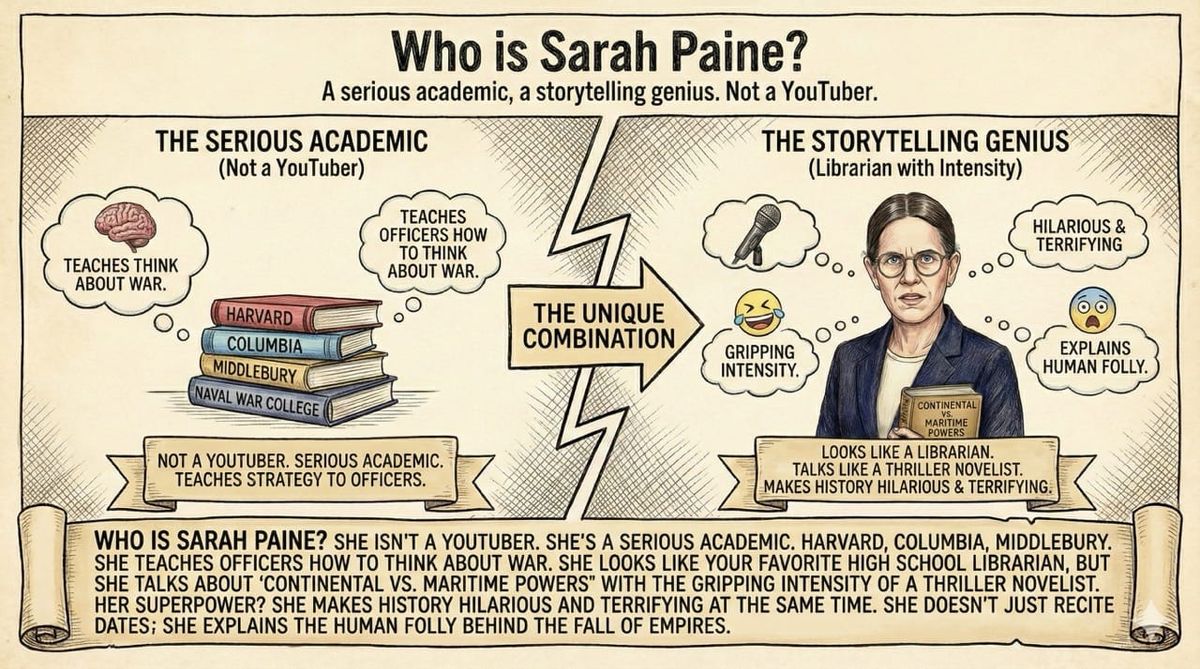
She isn’t a YouTuber. She’s a serious academic. Harvard, Columbia, Middlebury. She teaches officers how to think about war.
She looks like your favorite high school librarian, but she talks about “continental vs. maritime powers” with the gripping intensity of a thriller novelist.
Her superpower? She makes history hilarious and terrifying at the same time. She doesn’t just recite dates; she explains the human folly behind the fall of empires.
The “Viral” Theories
Her ideas are meme-ready. They stick in your brain.
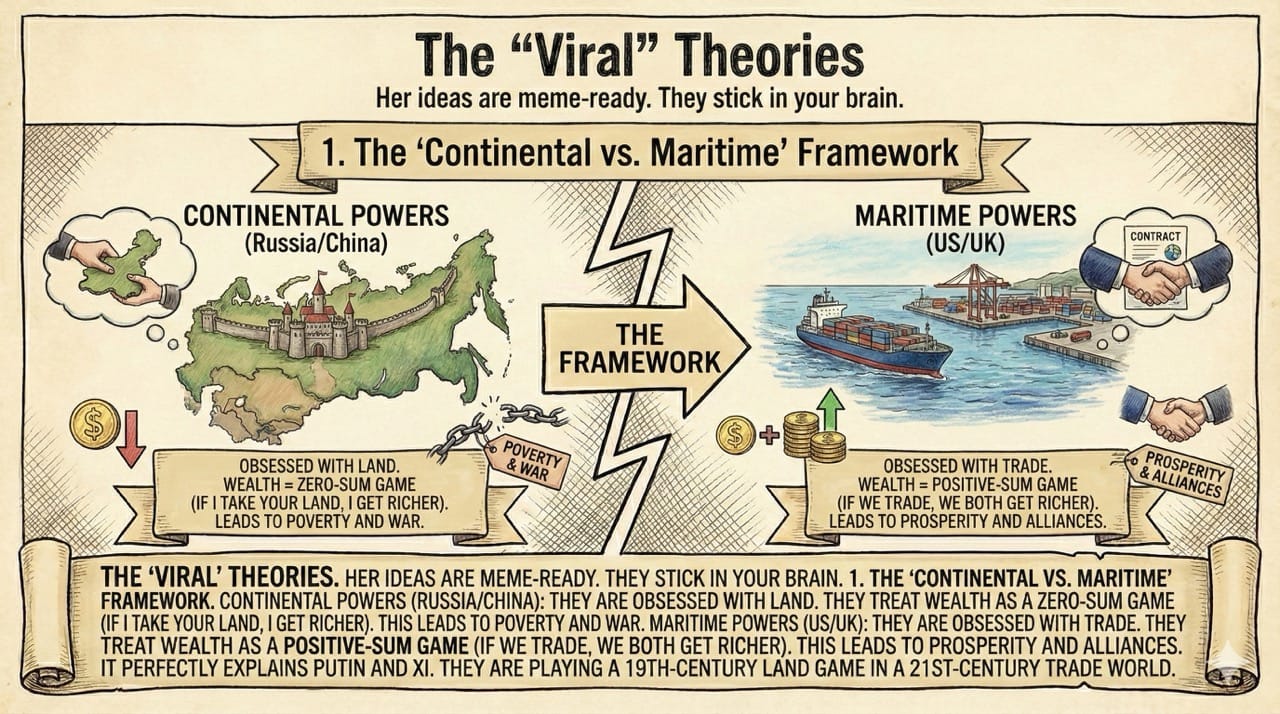
1. The “Continental vs. Maritime” Framework
- Continental Powers (Russia/China): They are obsessed with land. They treat wealth as a zero-sum game (if I take your land, I get richer). This leads to poverty and war.
- Maritime Powers (US/UK): They are obsessed with trade. They treat wealth as a positive-sum game (if we trade, we both get richer). This leads to prosperity and alliances.
It perfectly explains Putin and Xi. They are playing a 19th-century land game in a 21st-century trade world.
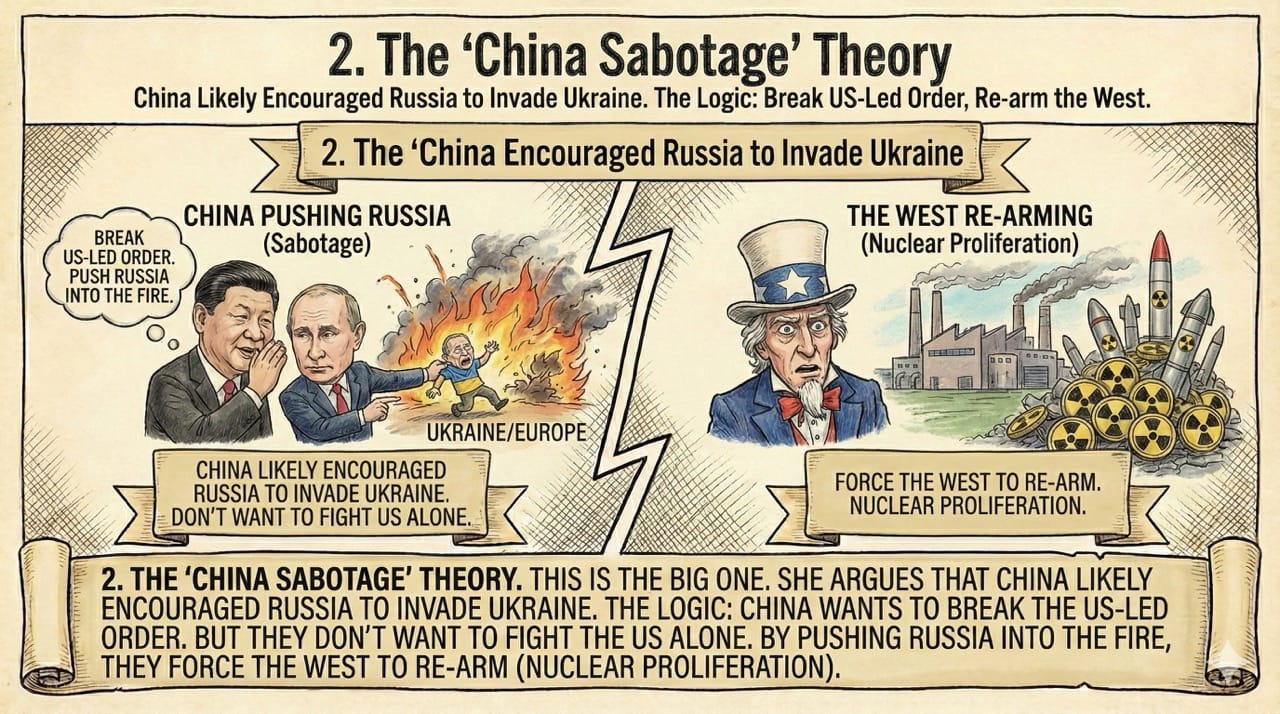
2. The “China Sabotage” Theory This is the big one. She argues that China likely encouraged Russia to invade Ukraine.
The Logic: China wants to break the US-led order. But they don’t want to fight the US alone. By pushing Russia into the fire, they force the West to re-arm (nuclear proliferation).
The Goal: It creates a chaotic, multi-polar world where the US is distracted, and nuclear weapons are everywhere—making the “Global Policeman” role impossible. It’s a terrifyingly cynical masterstroke.
The “No-Platform” Star
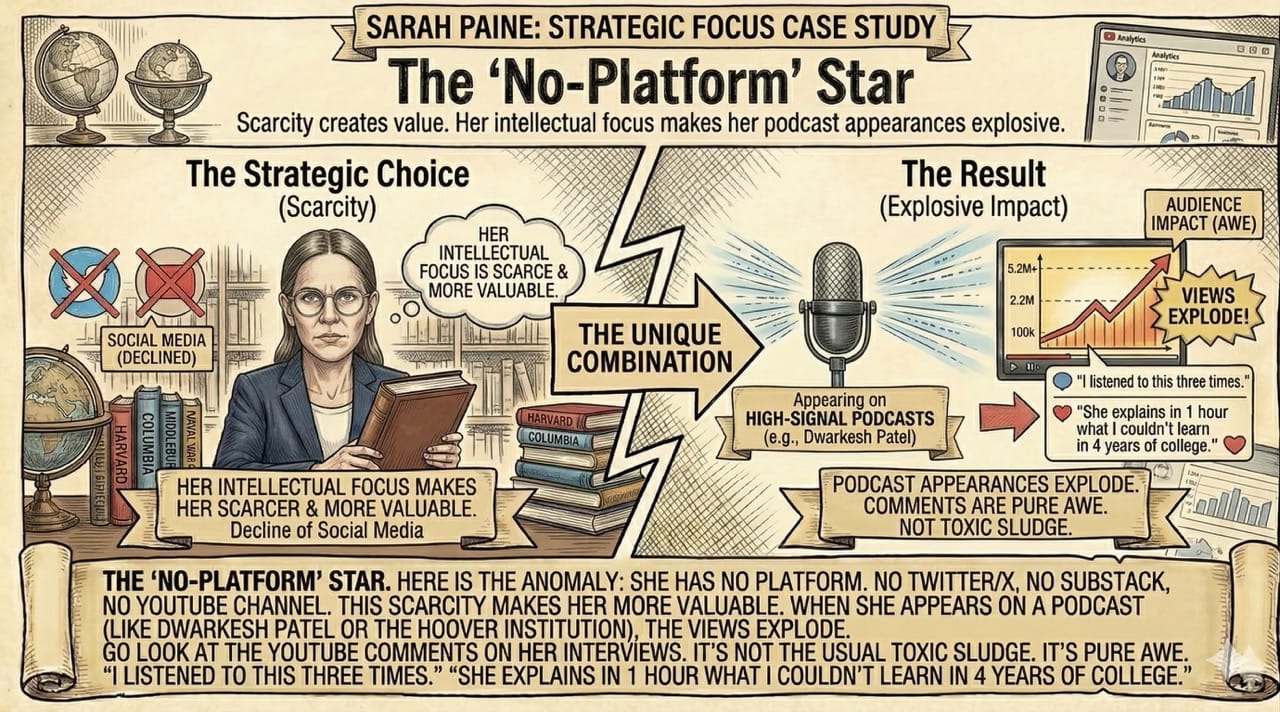
Here is the anomaly: She has no platform. No Twitter/X, no Substack, no YouTube channel.
This scarcity makes her more valuable. When she appears on a podcast (like Dwarkesh Patel or the Hoover Institution), the views explode.
Go look at the YouTube comments on her interviews. It’s not the usual toxic sludge. It’s pure awe. “I listened to this three times.” “She explains in 1 hour what I couldn’t learn in 4 years of college.”
Why Now?
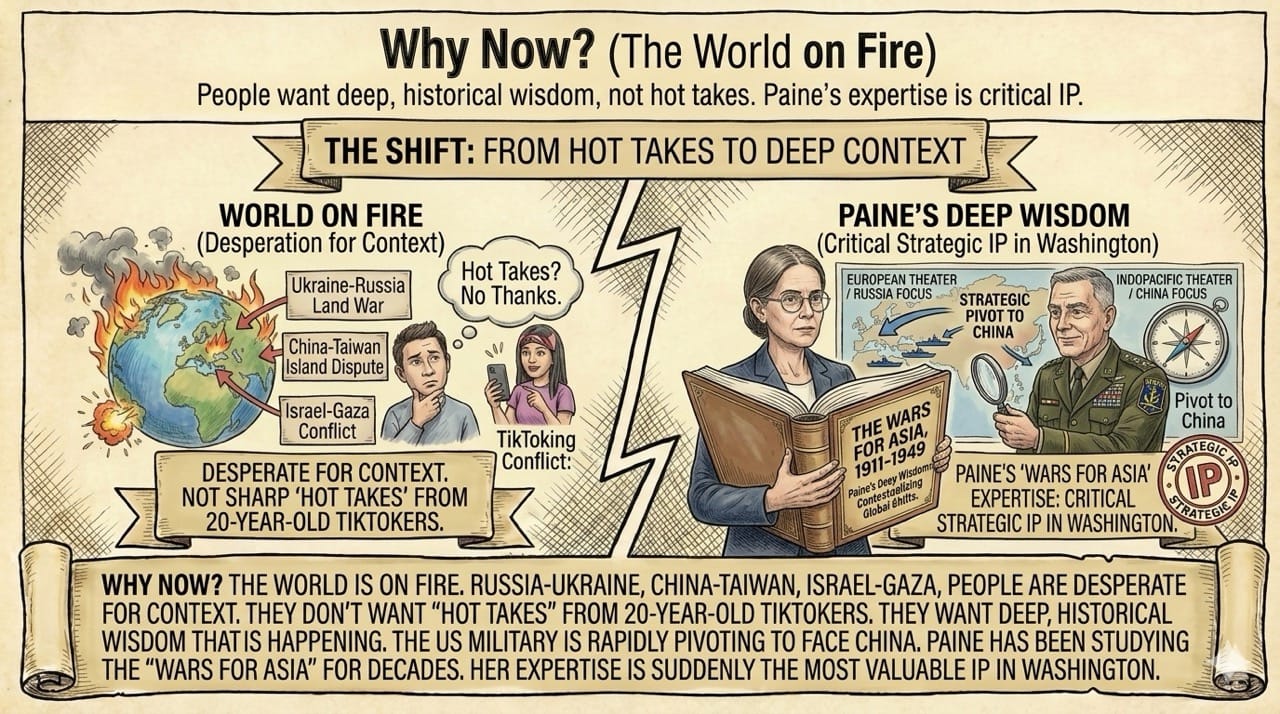
The world is on fire. Russia-Ukraine, China-Taiwan, Israel-Gaza.
People are desperate for context. They don’t want “hot takes” from 20-year-old TikTokers. They want deep, historical wisdom that explains why this is happening.
The US military is rapidly pivoting to face China. Paine has been studying the “Wars for Asia” for decades. Her expertise is suddenly the most valuable IP in Washington.
Conclusion: The Historian We Need
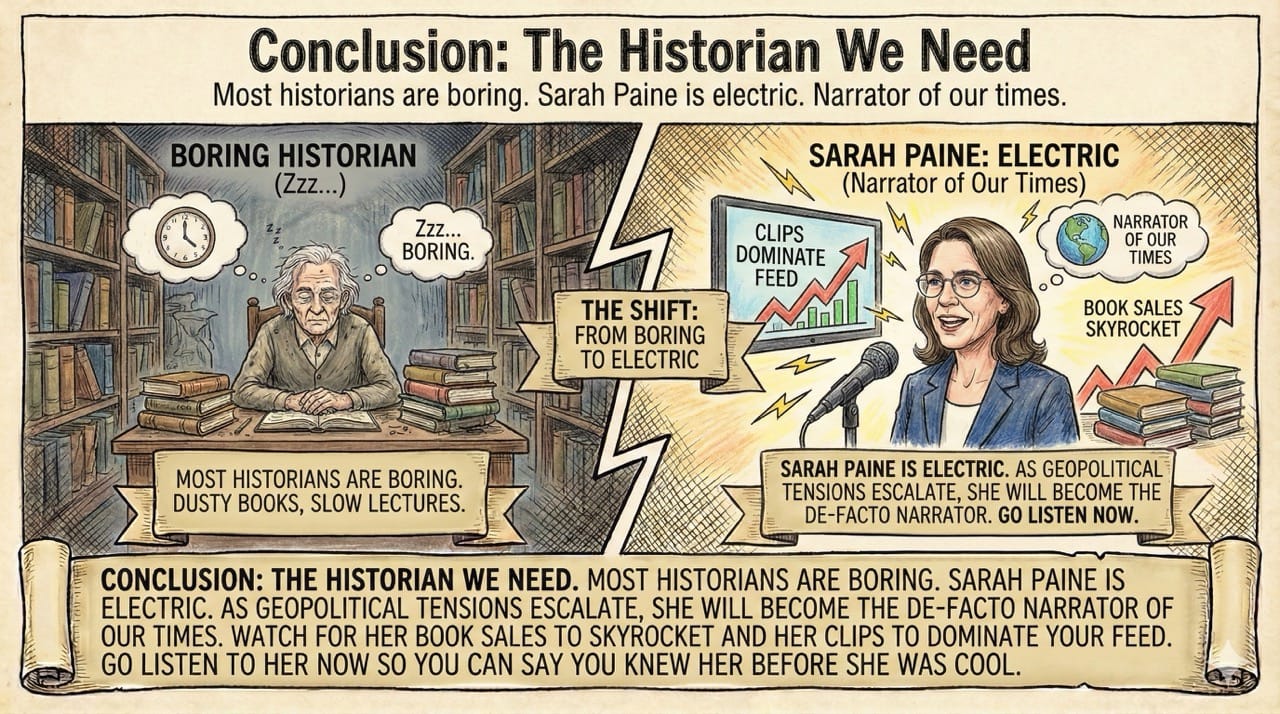
Most historians are boring. Sarah Paine is electric.
As geopolitical tensions escalate, she will become the de-facto narrator of our times. Watch for her book sales to skyrocket and her clips to dominate your feed.
Go listen to her now so you can say you knew her before she was cool.
Part 2: The Sarah Paine Syllabus (The Deep Dive)
If you are sold on the “who,” you need to understand the “what.”
Most people stop at the podcasts. But if you want to understand the operating system of the next decade, you have to go deeper. Paine’s real alpha isn’t just in her interviews; it’s in her books. They are expensive, dense, and hard to find. They are also the best investment you can make this year.
The “Missing” Theory: Institutions vs. Dictators
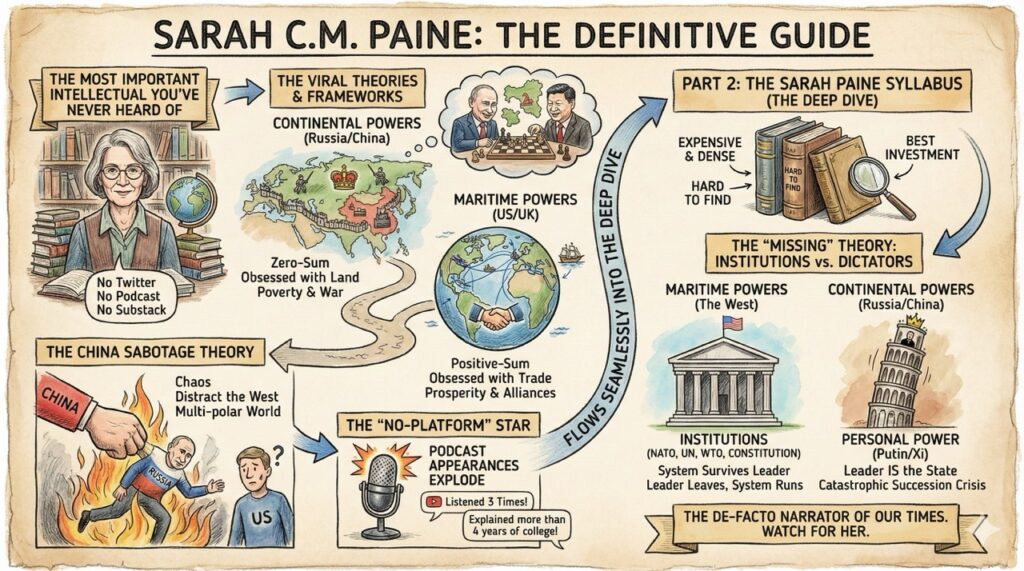
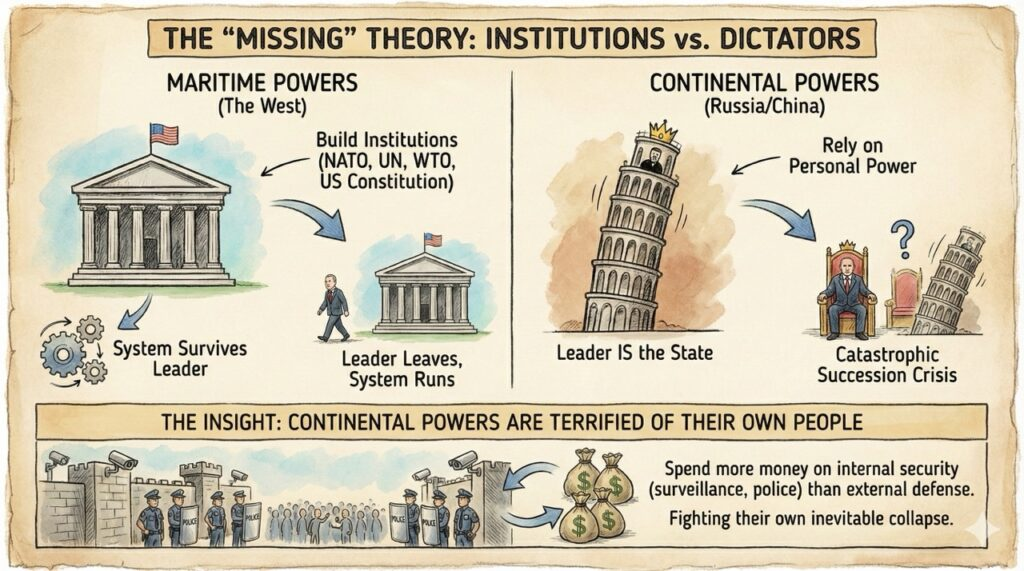
While the Maritime vs. Continental framework gets the headlines, there is a second layer to her work that explains the stability (or lack thereof) in global superpowers. It is the distinction between Institutional Power and Personal Power.
- Maritime Powers (The West): We build institutions (NATO, the UN, the WTO, the US Constitution). These systems are designed to survive the leader. If the President leaves office, the system keeps running.
- Continental Powers (Russia/China): They rely on personal power. The leader is the state. If Putin or Xi disappears tomorrow, the entire system faces a catastrophic succession crisis.
The Insight: Continental powers are terrified of their own people. They spend more money on internal security (surveillance, police) than external defense. They aren’t just fighting the West; they are fighting their own inevitable collapse.
The Reading List (For the Serious)
If you want to rank in the top 1% of geopolitical thinkers, these are the three books you need on your shelf. Warning: These are not pop-history. They are manuals for grand strategy.
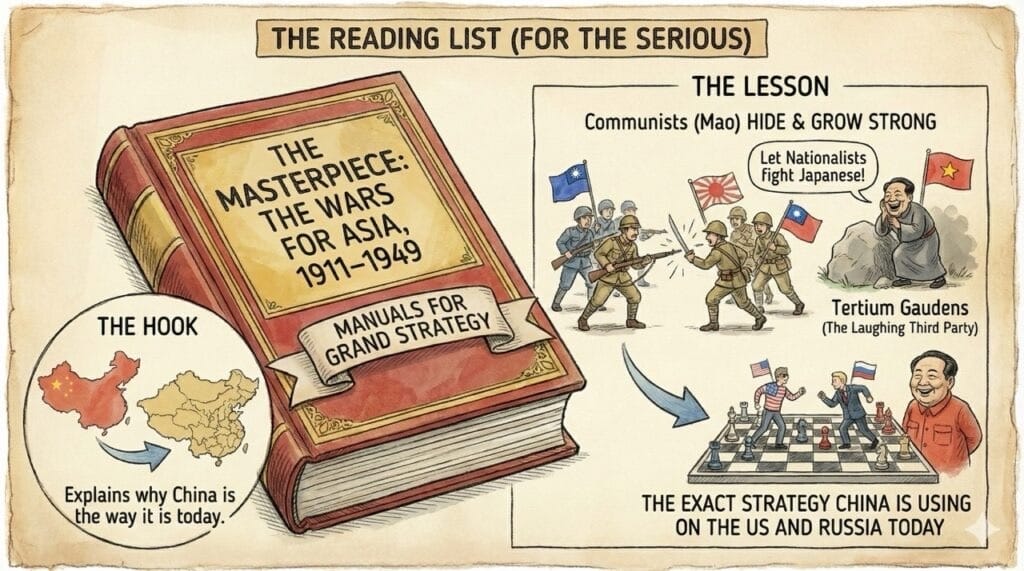
1. The Masterpiece: The Wars for Asia, 1911–1949
- The Hook: This book explains why China is the way it is today.
- The Lesson: It details how the Communists (Mao) won not by fighting the Japanese, but by letting the Nationalists fight the Japanese while they hid and grew strong. It is a masterclass in cynicism and “tertium gaudens” (the laughing third party)—the exact strategy China is using on the US and Russia today.
2. The Warning: The Japanese Empire: Grand Strategy from the Meiji Restoration to the Pacific War
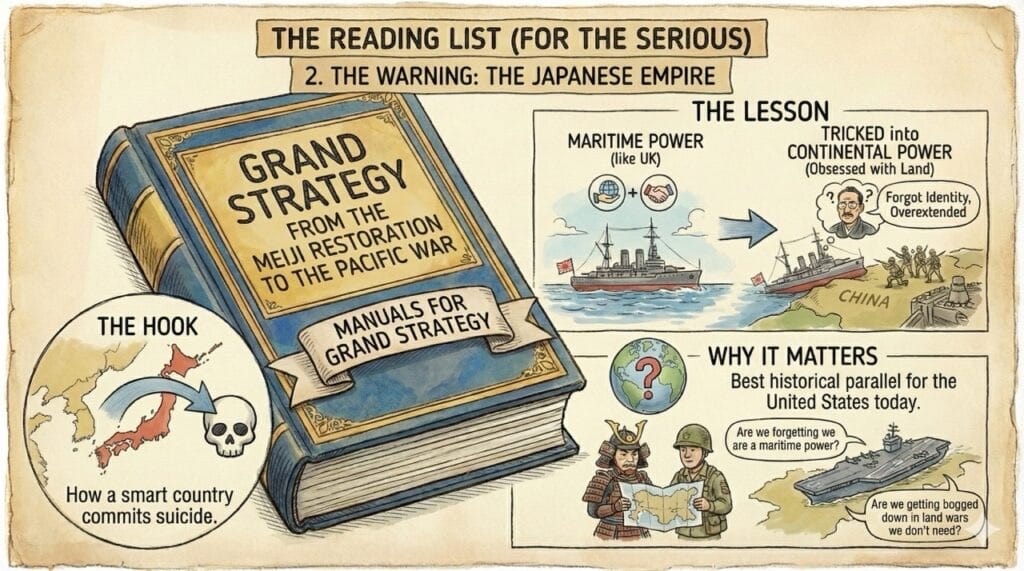
- The Hook: How a smart country commits suicide.
- The Lesson: Japan was a maritime power (like the UK) that got tricked into acting like a continental power (obsessed with land in China). They forgot their identity, overextended, and got crushed.
- Why it matters: It is the best historical parallel for the United States today. Are we forgetting we are a maritime power? Are we getting bogged down in land wars we don’t need?
3. The Blueprint: Nation Building, State Building, and Economic Development
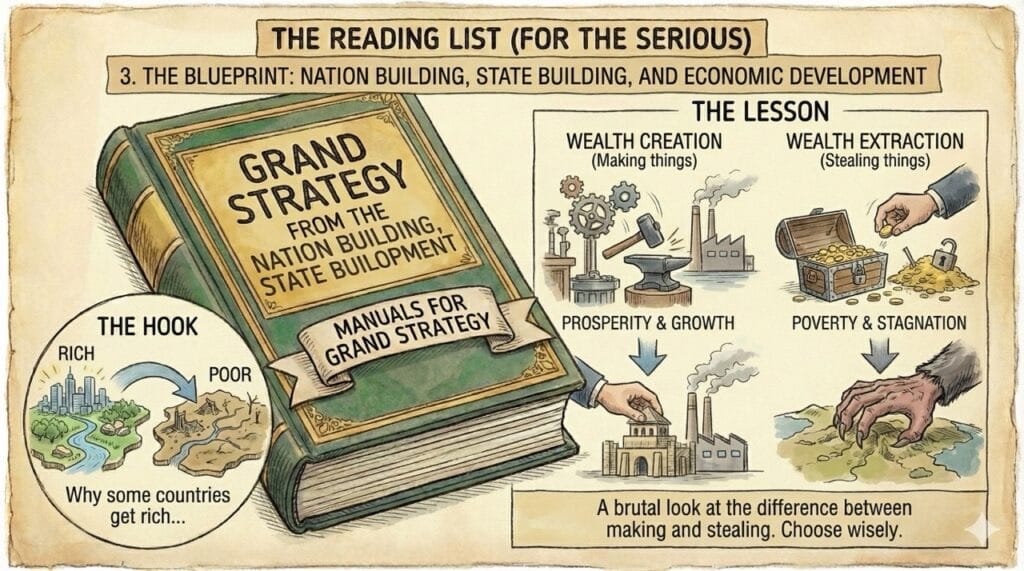
- The Hook: Why some countries get rich and others stay poor.
- The Lesson: A brutal look at the difference between “wealth creation” (making things) and “wealth extraction” (stealing things).
Why Her “Alliance” Thesis Wins
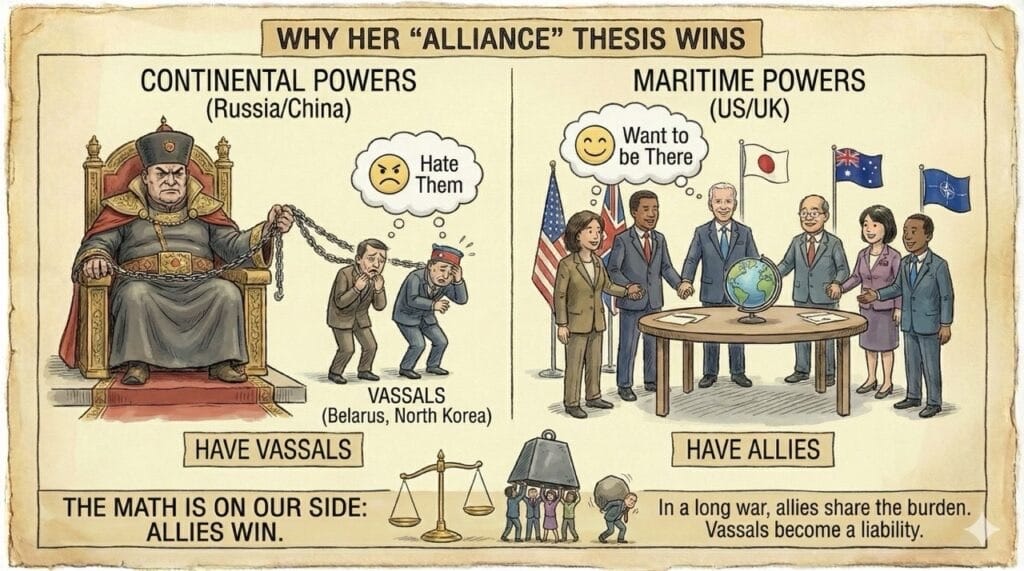
Finally, if you take one thing away from Paine, let it be this: Continental powers have vassals; Maritime powers have allies.
- Russia has Belarus and North Korea (vassals who hate them).
- The US has the UK, Japan, Australia, and NATO (allies who want to be there).
In a long war, allies share the burden. Vassals become a liability. This is why, despite the chaos, the math is still on our side.
Final Thought: The “Narrator” of the 2020s
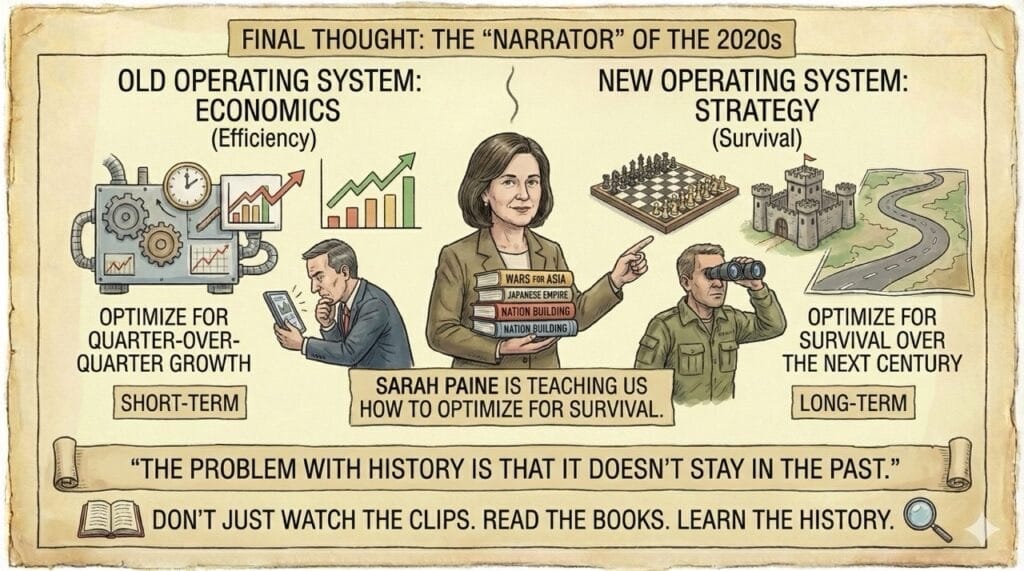
We are moving from a world of “Economics” (efficiency) to a world of “Strategy” (survival). Most analysts are still using the old operating system, trying to optimize for quarter-over-quarter growth. Sarah Paine is teaching us how to optimize for survival over the next century.
Don’t just watch the clips. Read the books. Learn the history. Because as she likes to say: “The problem with history is that it doesn’t stay in the past.”
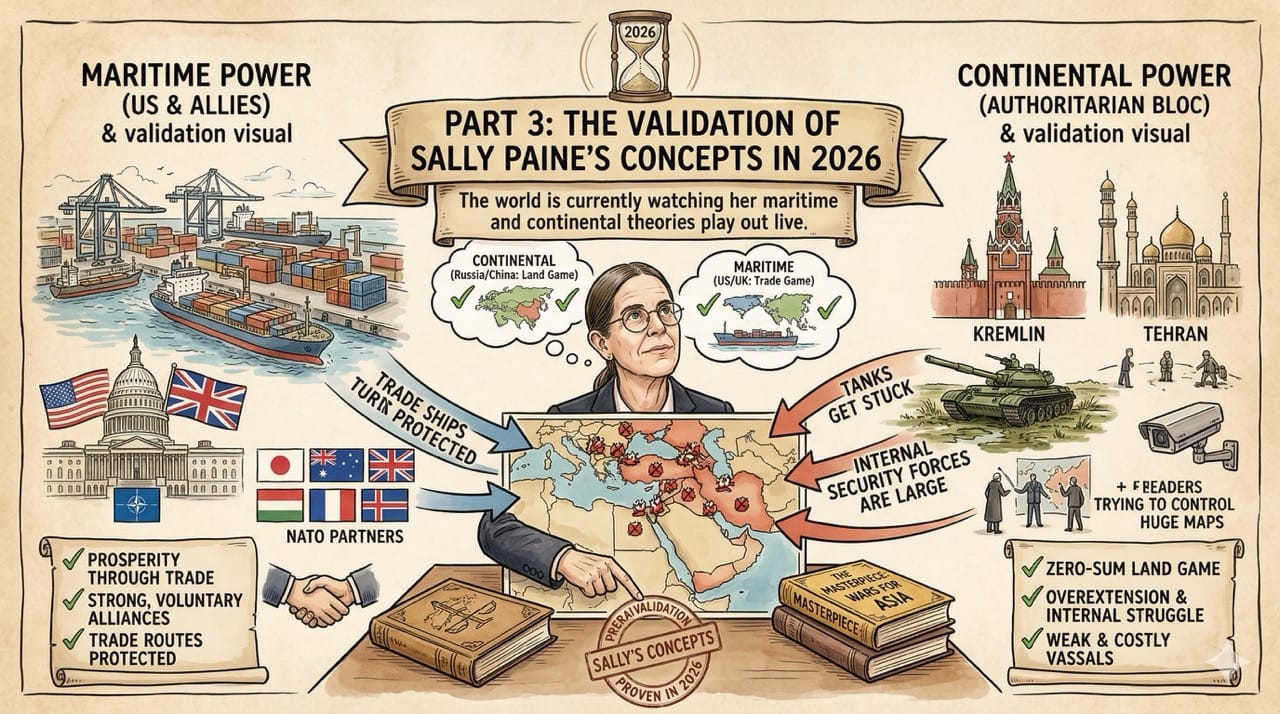
Part 3: The Validation of Sally Paine's Concepts in 2026
The world is currently watching her maritime and continental theories play out live in the Middle East and Eastern Europe.
Inspiration: Extending the previous analysis of Sally Paine by applying her exact academic frameworks to the current conflict between the United States and Iran. Realizing her warnings about continental overextension and maritime alliances were completely accurate.
The Continental Playbook in Action
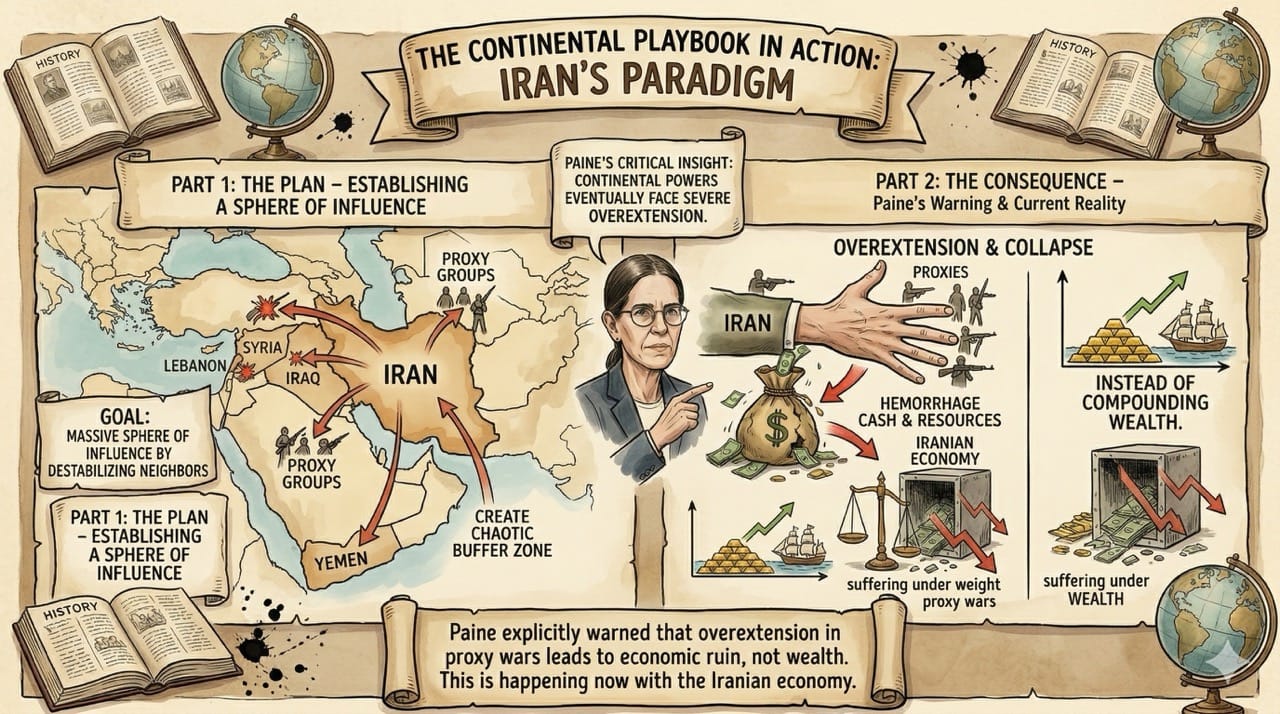
Iran is operating on a flawless continental security paradigm.
Their primary goal is to establish a massive sphere of influence by destabilizing their immediate neighbors.
They fund proxy groups across the Middle East to create a chaotic buffer zone around their borders.
Paine explicitly warned that continental powers eventually face severe overextension.
They hemorrhage cash and resources trying to dominate their surrounding region instead of compounding wealth.
We are seeing this exact collapse right now with the Iranian economy suffering under the weight of endless proxy wars.
The Maritime Chemotherapy
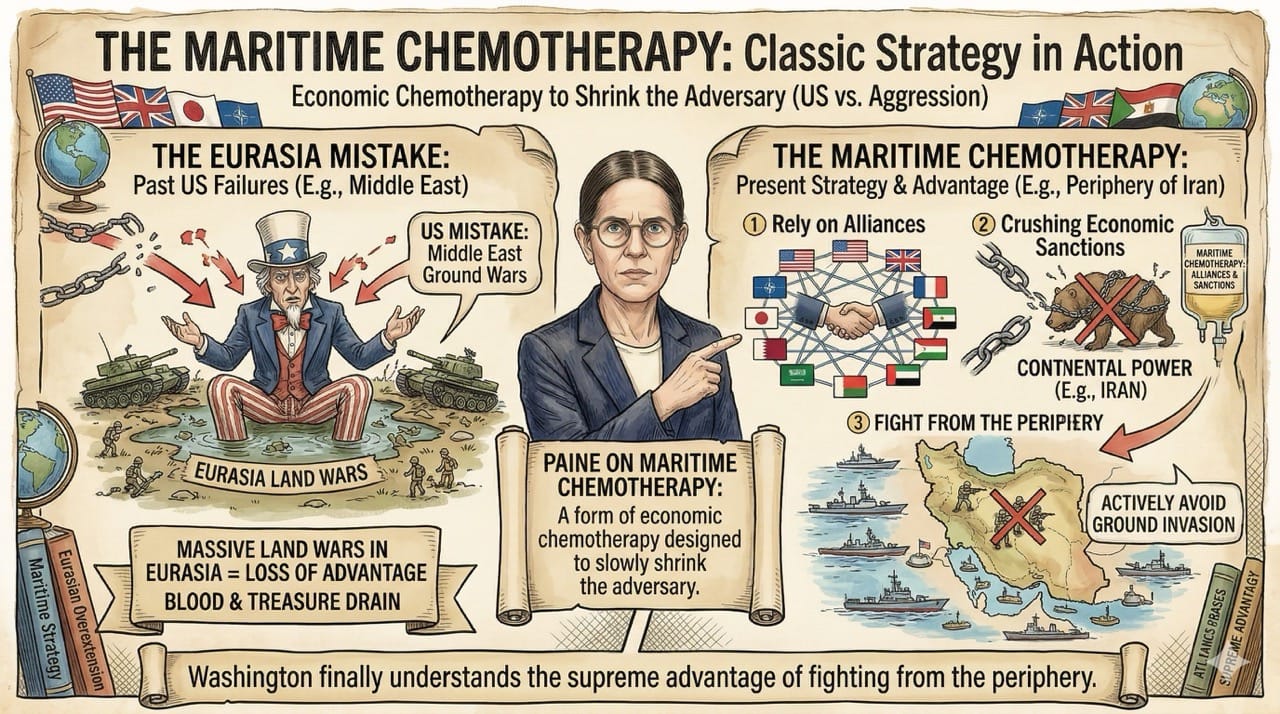
The United States is successfully applying the classic maritime strategy against this aggression.
They are relying on alliances and crushing economic sanctions rather than committing massive ground troops to a main front.
Paine accurately describes this approach as a form of economic chemotherapy designed to slowly shrink the adversary.
Throughout history, maritime powers lose their advantage the moment they commit to massive land wars in Eurasia.
The United States made this exact mistake previously in the Middle East.
Washington is now actively avoiding a direct ground invasion of Iran because they finally understand the supreme advantage of fighting from the periphery.
The Wealth Compounding Defense
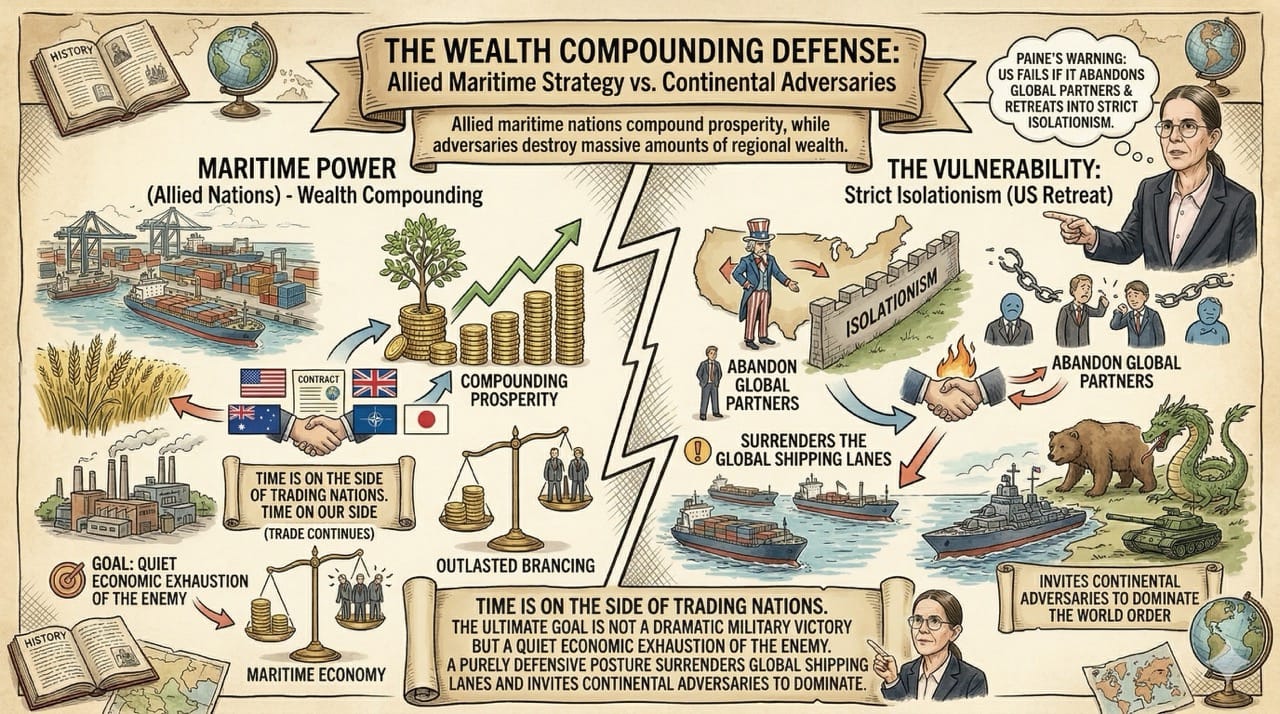
While adversaries destroy massive amounts of regional wealth, the allied maritime nations are compounding their own prosperity.
The maritime strategy recognizes that time is always on the side of the trading nations.
The ultimate goal is not a dramatic military victory but a quiet economic exhaustion of the enemy.
Paine also highlights the only way the maritime alliance can actually lose this conflict.
The United States will fail if it abandons its global partners and retreats into strict isolationism.
A purely defensive posture surrenders the global shipping lanes and invites continental adversaries to dominate the world order.
Conclusion: The Geography of Destiny
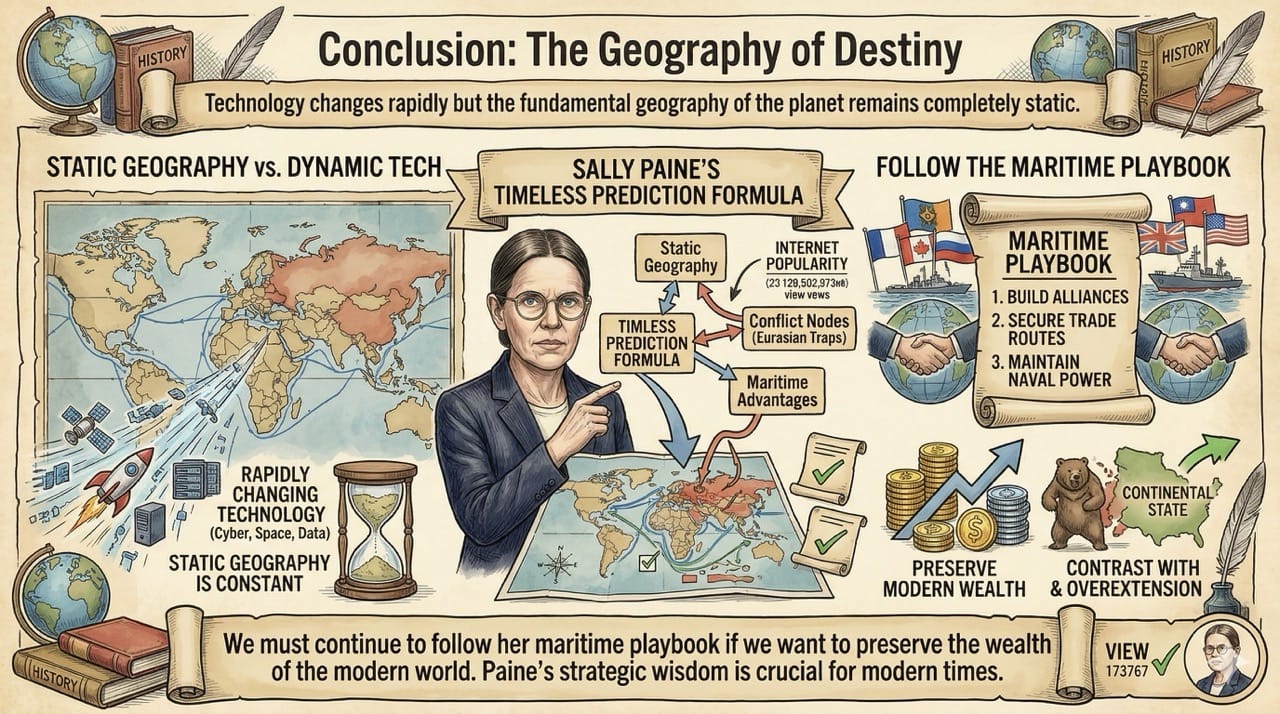
Technology changes rapidly but the fundamental geography of the planet remains completely static.
Sally Paine is gaining internet popularity because she provides a timeless formula for predicting global conflict.
We must continue to follow her maritime playbook if we want to preserve the wealth of the modern world.